Our Churches
Edenderry, Rhode & Clonbullogue Parish · County Offaly
Six churches, one community of faith. From the striking Romanesque arches of St. Mary's to the quiet limestone walls of the Sacred Heart, each building carries the prayers and perseverance of generations who built them — often in times of great hardship — as enduring signs of hope.
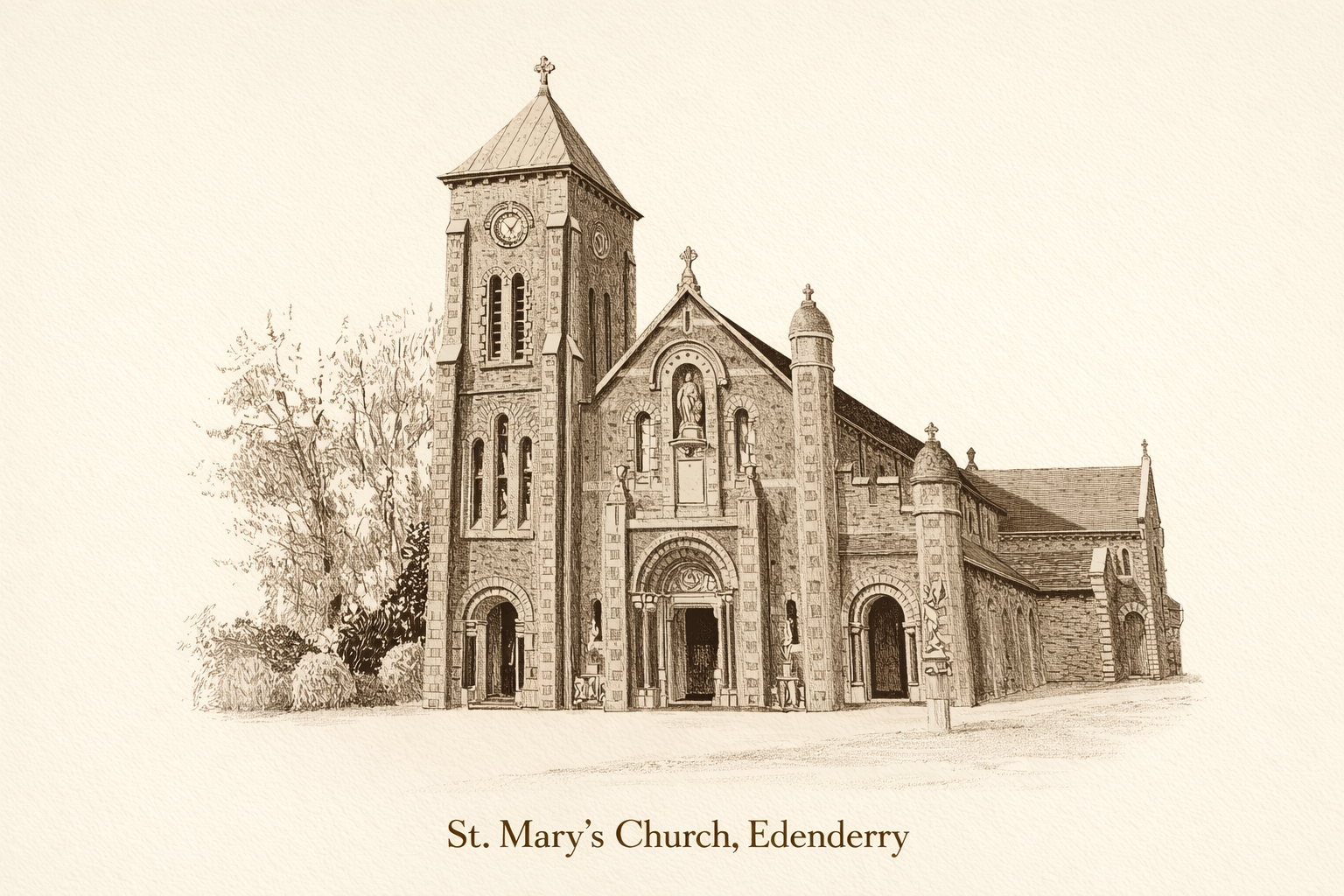
St. Mary's Church, Edenderry
The principal church of Edenderry Parish — a striking Hiberno-Romanesque building that reflects both the faith and determination of the local community in the early 20th century.
Edenderry — from the Irish Éadan Doire, meaning "the hill brow of the oak woods" — takes its name from the densely wooded area overlooking the town. In the 16th century the place was known as Coolestown, after the Cooley (or Cawley) family. The town itself was founded by Lord Downshire (1788–1845), who also built Blessington, Co. Wicklow.
The area's ecclesiastical history runs deep. Pierce de Bermingham, an early settler, established a Franciscan monastery in 1325. Known as Mainistir Mhic Feorais — later Monasteroris — it accommodated over 300 students before its suppression under Henry VIII. A Celtic Cross and a holy water stoup inscribed "M.C. 1742" from the earlier chapel at Cokery Lane are still preserved.
The old parish church at Killane was built in 1816 by Fr. James Colgan P.P. Several items from that church — including stained glass windows, black marble water fonts, and the high altar (now in the mortuary chapel) — were later transferred to St. Mary's. A picture of Our Lady of Perpetual Succour, brought from Rome by Fr. John Kinsella P.P. (1882–1905), is also housed in the chapel.
The foundation stone of St. Mary's was laid by Bishop Patrick Foley in 1914. Fr. Paul Murphy P.P. (1910–1933), a native of Co. Cork, undertook the massive task of building the church. The stone was brought by horse and cart from a quarry near Tullamore by the O'Neill brothers of Clonmullen. The architect, William Scott, was the first Professor of Architecture at the National University of Ireland, Dublin.
Two building contractors worked on the project: William Connolly & Sons until 1916, and Jeremiah Coffey of Midleton, Co. Cork from 1918. The church opened, sparsely furnished, in June 1919. In the late 1920s the altar, pulpit, altar rails, and statues were carved and erected by an Italian firm, with the interior design by Ashlin and Coleman, Architects. New church benches were installed in 1922, and a beautiful marble pulpit — bearing a bust of Fr. Murphy — was erected in 1930.
In 1932 the church was consecrated by Bishop Matthew Cullen, confirming that all debts had been cleared. Less than six months later, Fr. Murphy died. A tombstone in the grounds reads: "If you seek a monument, look around." He also placed clay from all local cemeteries beneath the communion rails, so that parishioners would kneel on the hallowed dust of their forebears. Fr. Murphy provided a new Convent for the Sisters of St. John of God and renamed several town streets — including Blundell Street, which became Fr. Paul Street. The total cost of building and contents came to £65,000 by 1929.
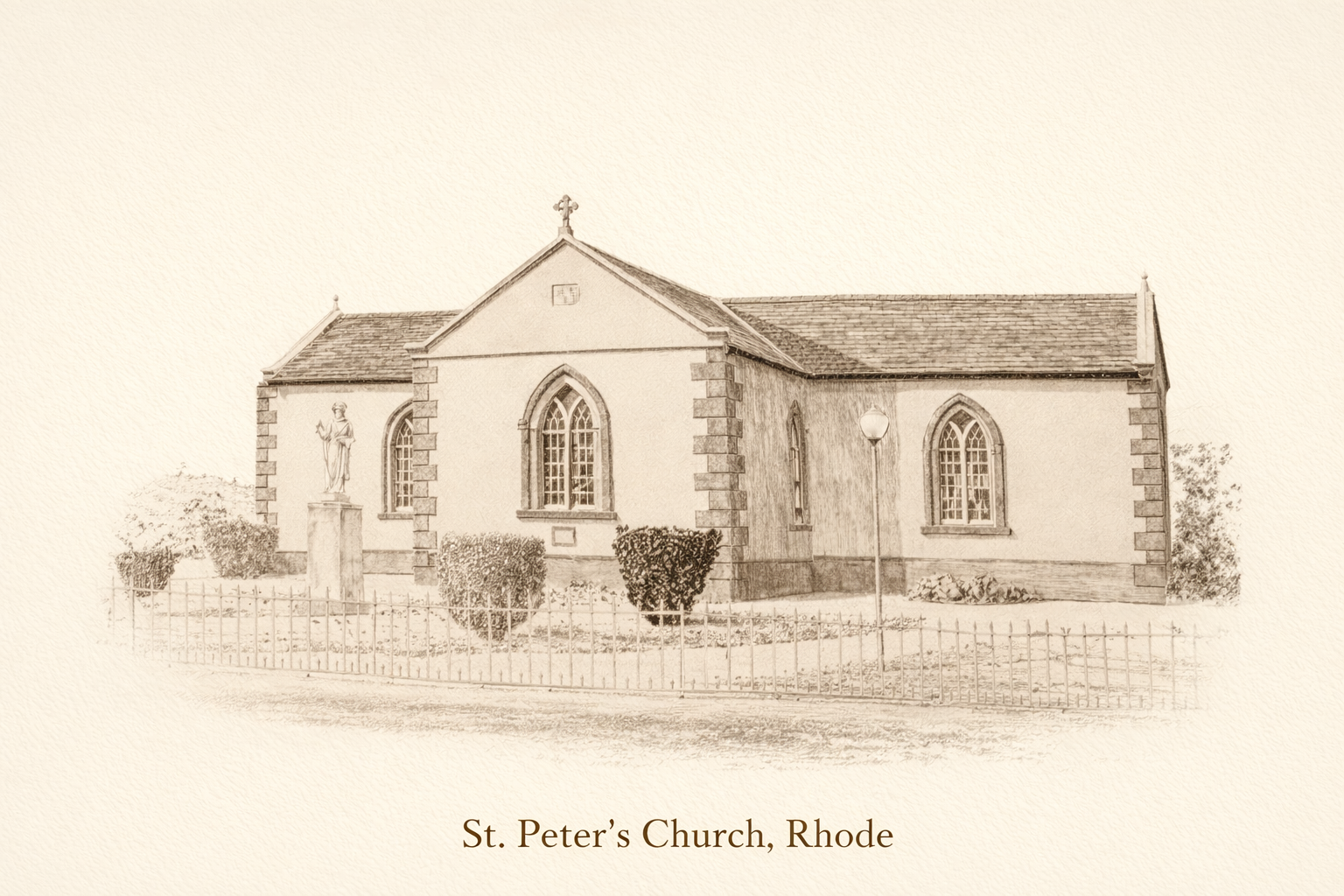
St. Peter's Church, Rhode
A historic rural church reflecting the continuity of Catholic worship in the area from penal times to the present day.
Rhode — from the Irish Ród (road, anchorage), with related forms Téad Róid (mooring rope) and Cloch Róid (mooring stone) — has deep roots in Catholic worship. In 1731, a return by the Protestant Rector of Primult, John Gibbin, confirmed that a Mass house had existed in the area since 1714, with one priest officiating. This chapel, about 40 perches from Rhode on the road to Coolcor, was later used as a school.
The site for the present church was a gift from Mr. Thomas Dames, a Protestant from Greenhill. The church is a cruciform building constructed mainly from cut stone, with finely-cut limestone and teak mitred windows, finished with a slated roof and decorative ridge tiles. The foundation stone, in the boundary wall, reads: "St. Peter's chapel, built A.D. 1816, Rev. Js. Colgan P.P." Local tradesmen and masons built the church and also worked on later renovations.
Fr. James Colgan died in 1856. After his death, Bishop James Walsh established Rhode and Croghan as a separate parish. The church possesses a chalice of solid silver presented to Rev. Jeremiah Kehoe P.P. in 1860, and a fine stained glass window depicting St. Peter in chains, dating from c. 1912. The organ was purchased in 1992 from the De Vesci Estate in Abbeyleix.
The church was renovated and re-roofed in 1959 and the sanctuary was reconstructed in 1970. Today, it remains a central place of worship and community life.
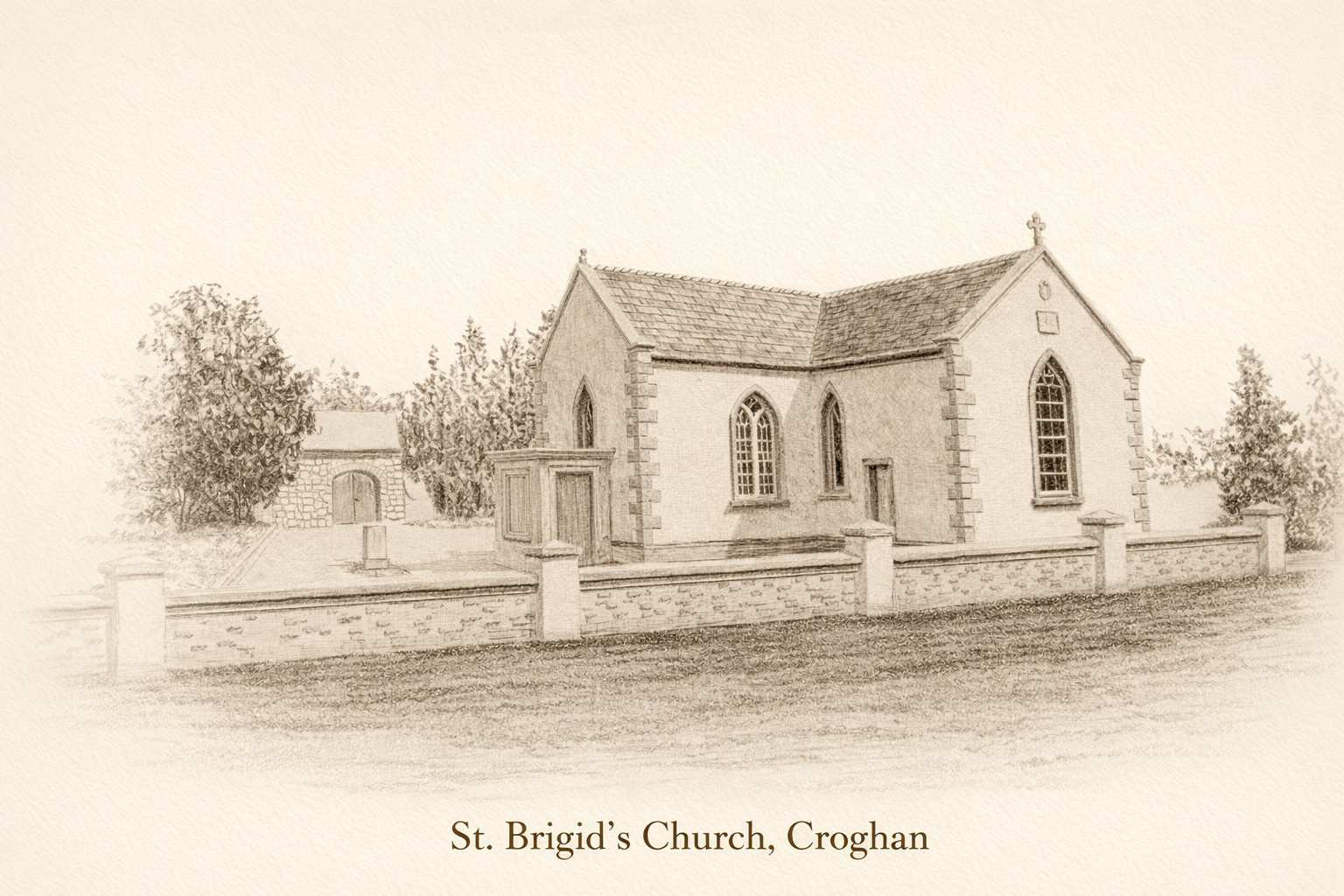
St. Brigid's Church, Croghan
Situated in a historically rich landscape, St. Brigid's Church in Croghan stands near ancient sites linked to early Irish Christianity.
Croghan — from Cruachan, meaning "a round or piled-up hill" — takes its name from the prominent hill that dominates the landscape. The Hill of Croghan commands a magnificent view and was, in ancient times, the territory of the O'Connors Faly, whose castle stood on the southwest. Legend has it that the hill was also visited by St. Patrick; a holy well there bears his name.
Before the construction of the present church, Mass was celebrated for several years in a barn belonging to Mr. Jonathan Dames. The church, built in 1827, is constructed from cut stone with teak mitred windows and a slated roof with decorative ridge tiles. It resembles Rhode Church but is smaller. Reconstruction work was carried out in 1966, and the sanctuary was reconstructed in 1972.
The chalice still in use at St. Brigid's is of solid silver, presented to Rev. Jeremiah Kehoe P.P. in 1859. Of special significance is the Irish Exhibition Altar, in carved oak and walnut, manufactured by C. Bull of 21 Suffolk Street, Dublin. It was enthusiastically reviewed in The Freeman's Journal in April 1908.
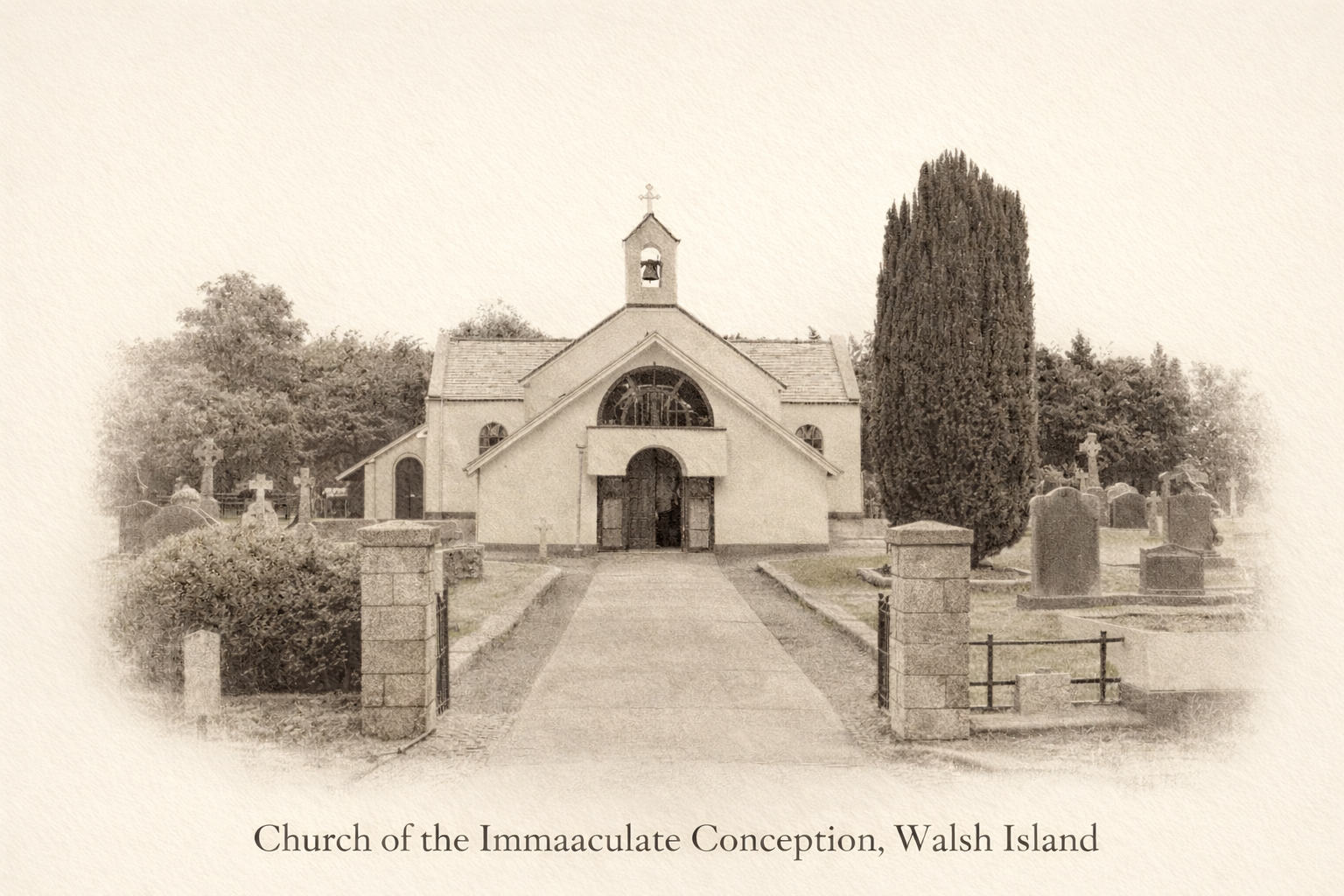
Immaculate Conception, Walsh Island
One of the oldest surviving churches in the area, serving a community shaped by bogland, agriculture, and strong faith traditions.
In Bishop MacGeoghegan's list of churches and chapels of Kildare from the early 1600s, Walsh Island is referred to as "Innish" — an island. The area, apart from a strip of land providing passage on the Daingean side through Ballinakill, was surrounded by deep marshy bogs which were not accessible until the Barrow Drainage Scheme was conducted in the 1930s.
The church was built c. 1824, supposedly on the site of an earlier church. It is one of the oldest surviving buildings in the area. Nearby, Ballintemple church, dating from the 15th century, is one of the oldest structures in Walsh Island.
Fr. James Breen, curate, was instrumental in having the first National Turf Cutting Competition brought to Monevane, Walsh Island, in 1935. The first sod was cut by President Éamon de Valera. As a result, the massive 4,000-acre development of Clonsast Bog began under the Turf Development Board, later to become Bord na Móna.
The church was renovated in the 1970s, when the balcony at the rear and confessionals were removed. Behind the altar is a treasured painting of the Mother and Child, which marries Byzantine with Western religious art — the work of an early 20th century Slavonic artist.
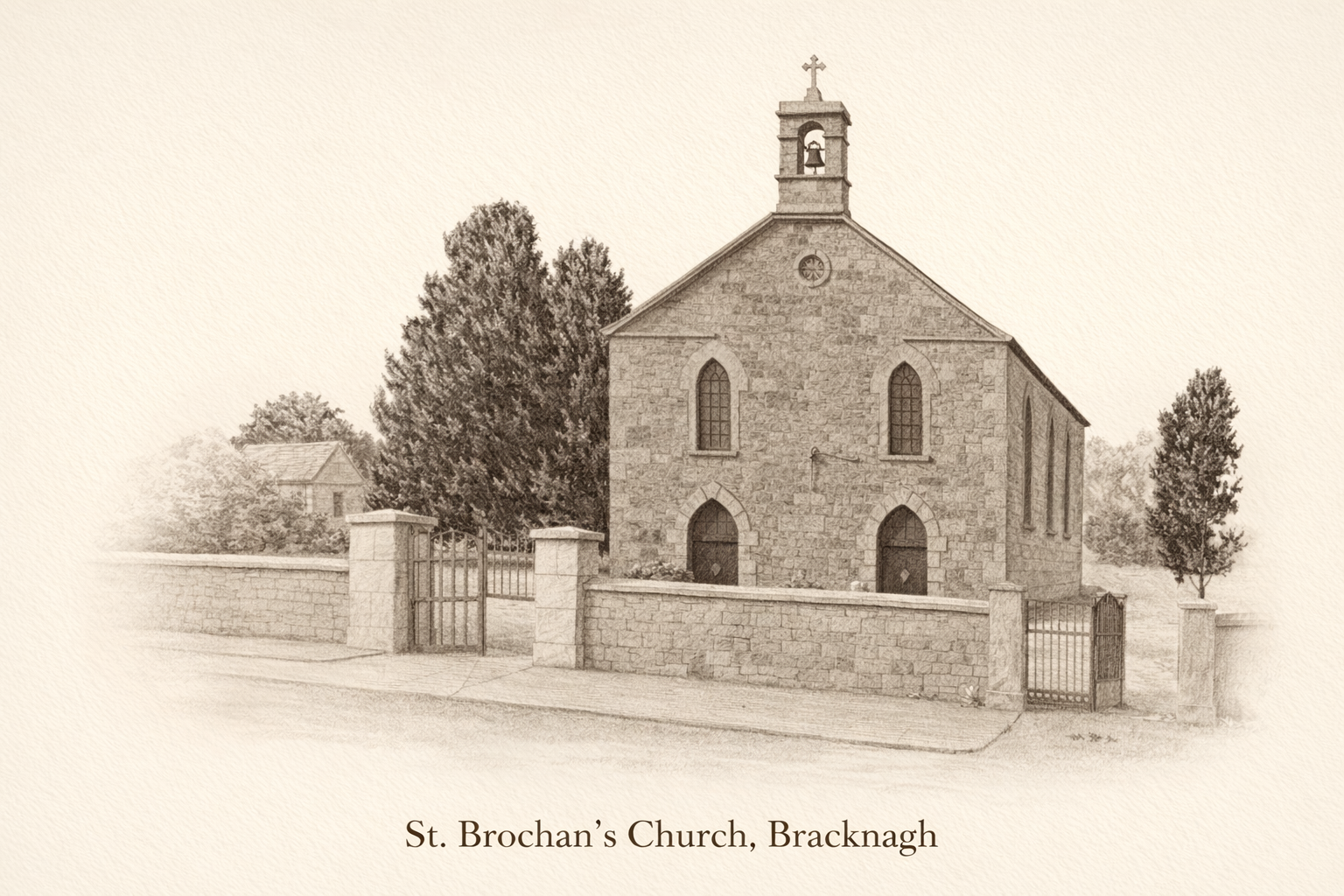
St. Broghan's Church, Bracknagh
A parish church rooted in both ancient monastic tradition and 19th-century revival, reflecting the deep Christian heritage of the area.
Bracknagh — Breachnach, meaning "a speckled place", or more likely a reference to Farran na Brachan, the territory of St. Brochan — is associated with one of the earliest monastic traditions in the area. The Leabhar Cluaina Sosta (Book of Clonsast) was produced here, a considerable portion of which is preserved in the Royal Irish Academy. Known also as the Leabhar Breac, it refers to a location near Athlone to which St. Broghan and his monks fled from Clonsast in the 7th century.
In 1798, Mass was said under a tree about 200 yards from Milgrove Bridge. The field was called the Priest's Island. Three priests are interred in the present church: Rev. John Dunne (d. 1856), who had been parish priest for 32 years; Rev. E. O'Leary (d. 1850); and the earliest interment, in March 1845, for Rev. James Murphy — suggesting the early 1840s as the time of construction. The church was re-ordered in the 1980s.
The ruins of an old church still stand in a field in Ballynowlart townland, on the road from Bracknagh to Rathangan. It is said that c. 1650 Cromwell and his troops burned the church, killing those within — known since as the "Ballynowlart Martyrs." An excavation in October 1917 unearthed the remains of 108 persons about eighteen inches below the surface. These were re-interred in Bracknagh.
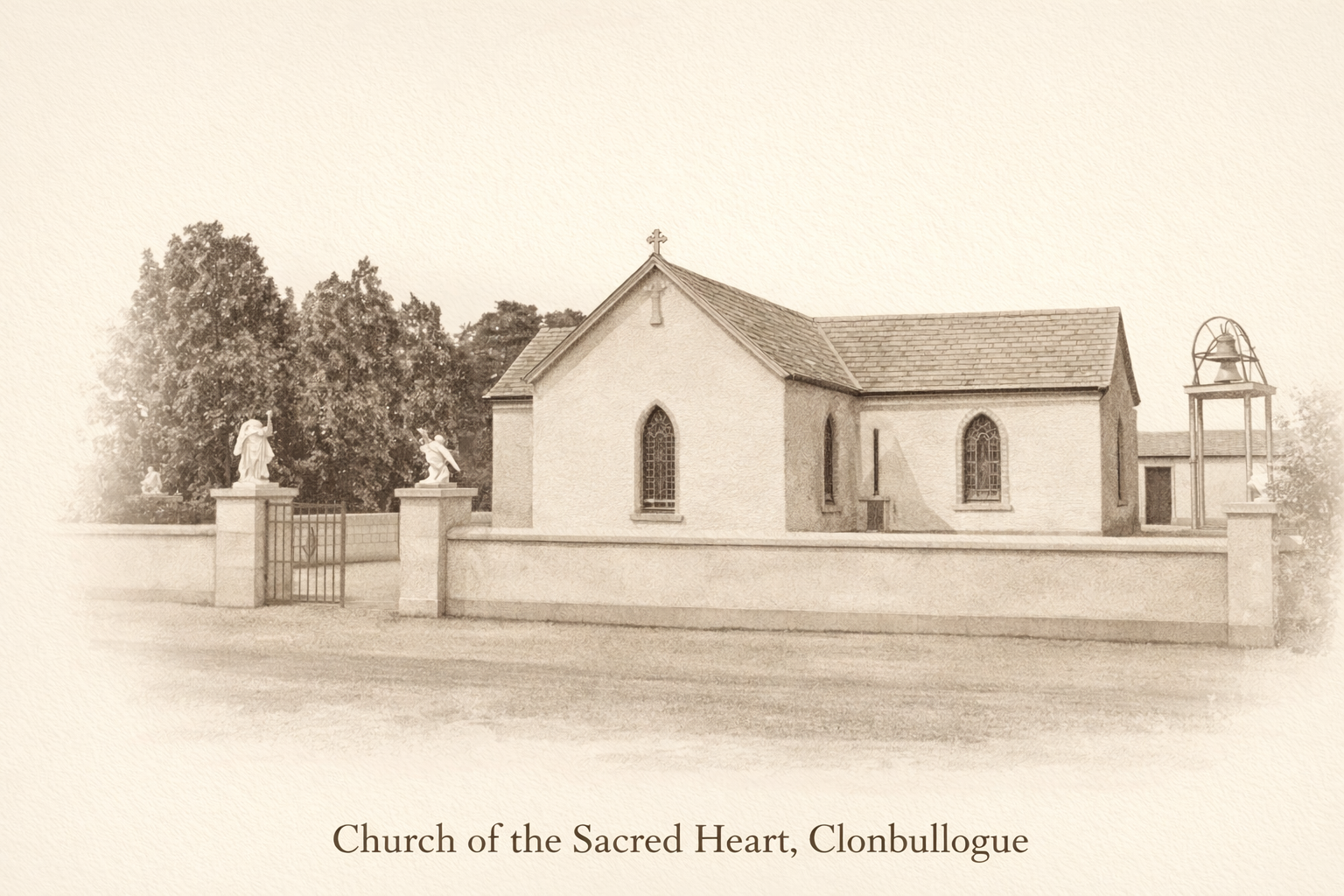
Sacred Heart, Clonbullogue
A simple but historically significant church, standing at the centre of the Clonbullogue community.
Clonbullogue — from Cluain Bollog, meaning "meadow of the grain" — is a village set in a fertile area surrounded by large tracts of bogland. The Church of the Sacred Heart was built c. 1820, during a period when Catholic communities were once again able to construct permanent places of worship.
The church is built of limestone and is cruciform in shape, like many of its style from the early 19th century. The front door is now at the rear of the church. In 1983, the building was renovated and the sanctuary reconstructed in keeping with the new liturgy.
In the nearby ruins of a church in Cloncrane is interred Rev. John Moore, P.P. of Clonbullock, who died in 1793. His chalice is preserved in Sacred Heart Church.
The parish also carries echoes of the 1798 Rebellion: on the Bracknagh road, Wexford rebels Fr. Mogue Kearns and Captain Anthony Perry were captured and later executed in Edenderry.