St Mary's Church
If you seek a monument, look around
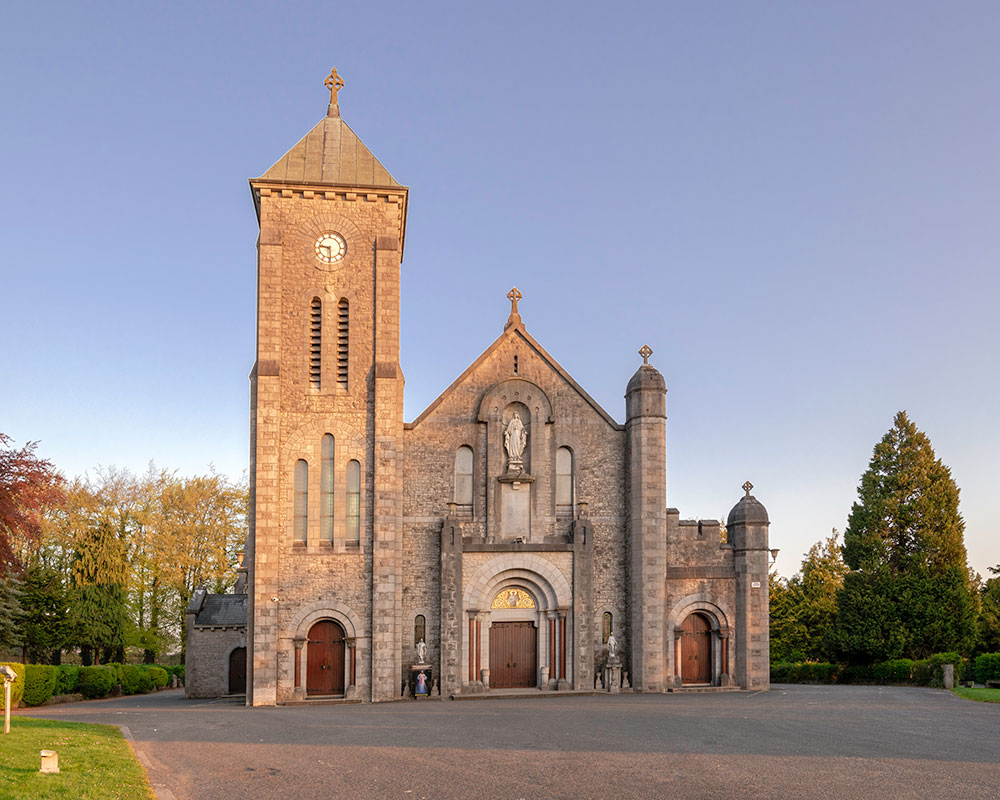
St. Mary's Church stands as a striking and enduring landmark in Edenderry, serving the faith community of Monasteroris and Edenderry for over a century. Built of carefully cut stone brought by horse and cart from a quarry near Tullamore by the O'Neill brothers of Clonmullen, the church is a large, imposing structure that reflects both architectural vision and deep pastoral dedication.
The name Edenderry comes from the Irish Eadan Doire — the hill brow of the oak woods — from the densely wooded area overlooking the town. In the 16th century, the place was known as Coolestown, after the family of Cooley (or Cawley) who held a castle in the area. The town itself was founded by Lord Downshire (1788–1845), who also built Blessington, Co. Wicklow.
Key Facts
Church opened
June 1919
Consecrated
1932 by Bishop Matthew Cullen
Architect
William Scott, NUI Dublin
Style
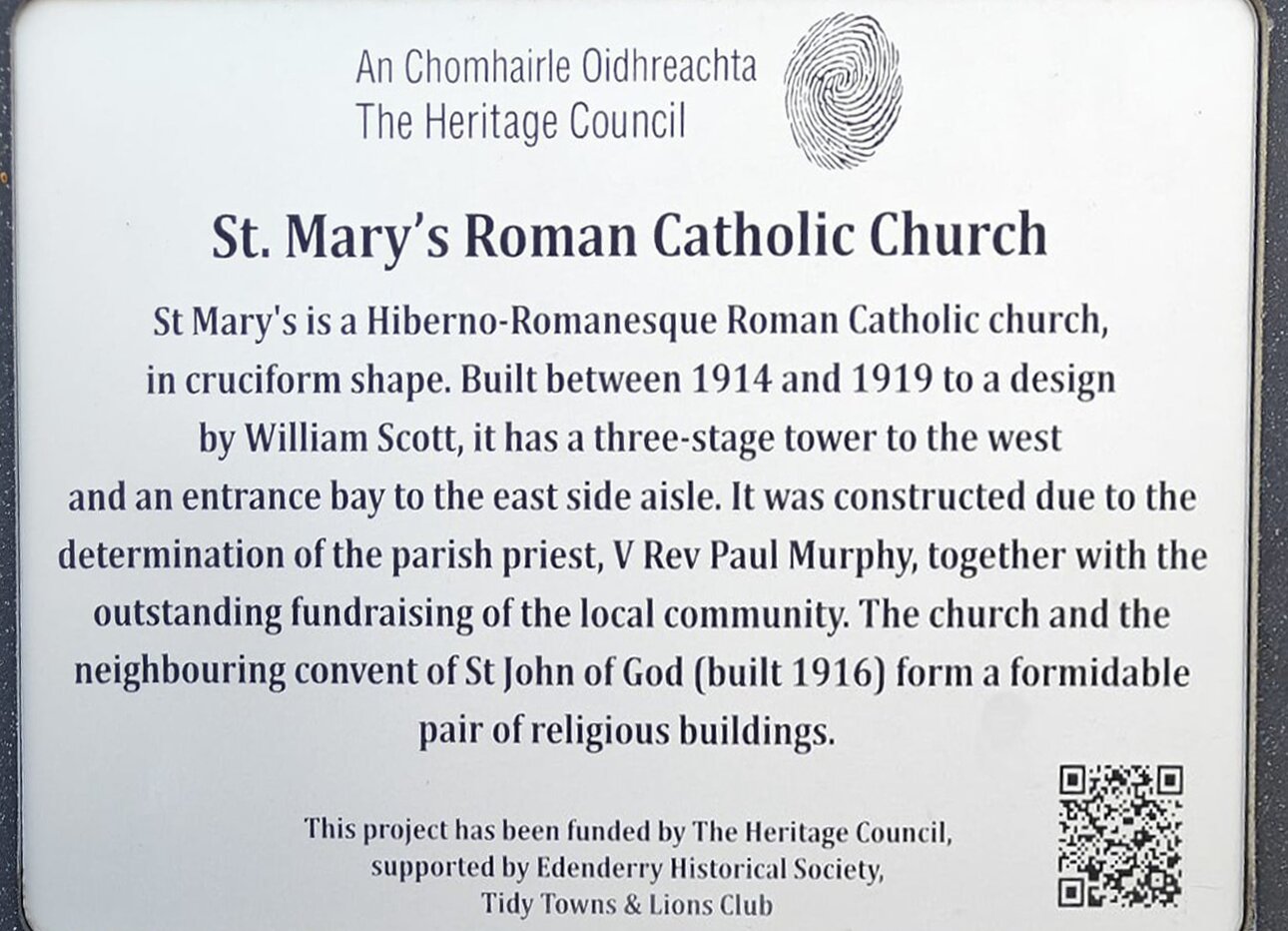
Hiberno-Romanesque, cruciform
Cost (building & contents to 1929)
£65,000
Building Pastor
Fr. Paul Murphy P.P. (1910–1933)
Ancient Roots
Pierce de Bermingham was an early settler who was granted large tracts of land in this area. In old Gaelic, "Pierce" was translated Feorais, and after the establishment of a Franciscan monastery in 1325, the name Mainister Mhic Feorais arose, later evolving into Monasteroris. The monastery was quite substantial, accommodating over 300 students. When the monasteries were suppressed by Henry VIII, the lands were granted to Nicholas Herbert at an annual rent of £4.
The old parochial church of Monasteroris was built in the 14th century and stood on the west side of the monastery. From an earlier chapel at Cokery Lane came a small Celtic Cross and a holy water stoup inscribed M.C. (Monasteroris Chapel) 1742. Another holy water stoup bears in its inscription the date 12+90.
Fr. Paul Murphy — Builder of St. Mary's
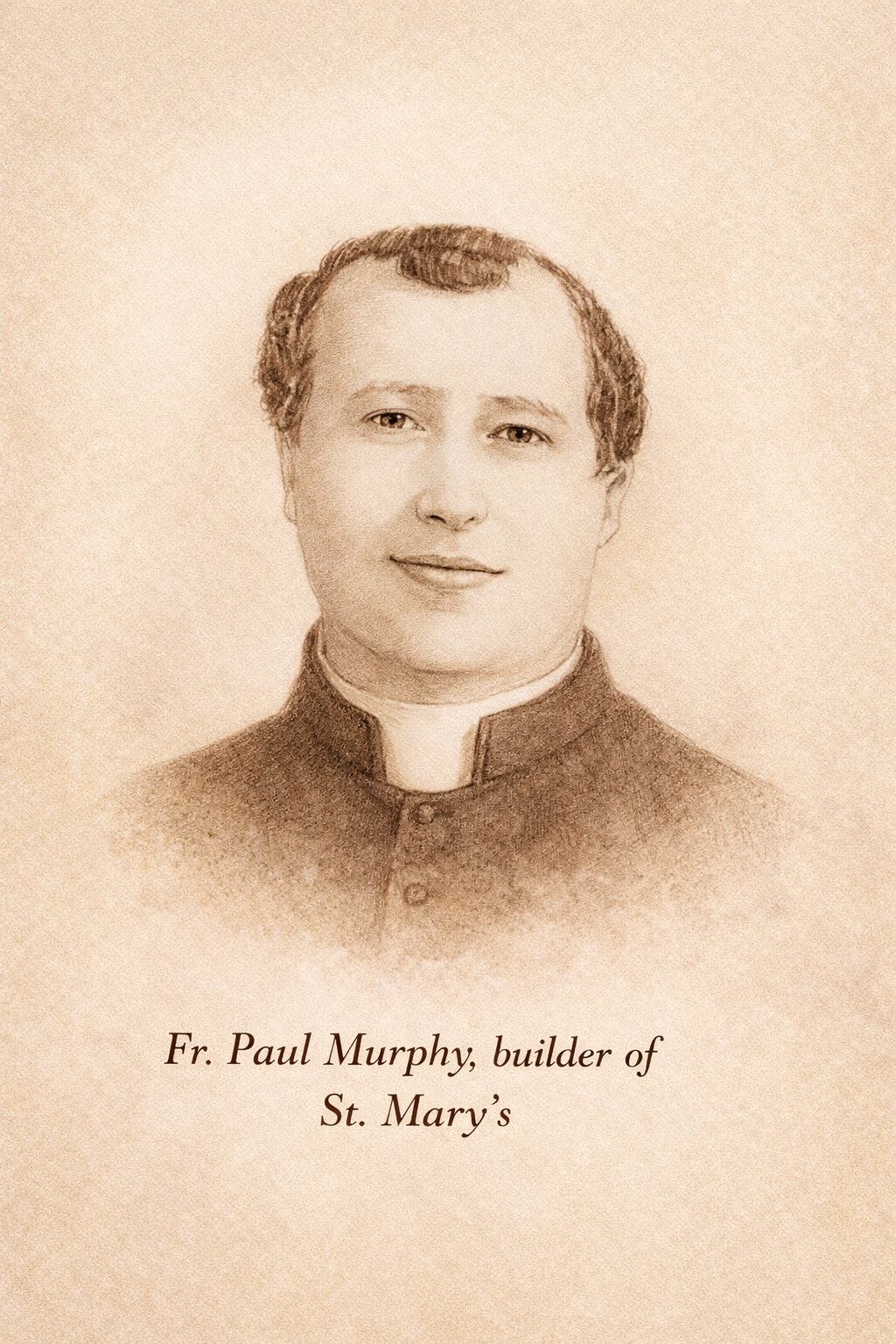
Fr. Paul Murphy P.P.
Parish Priest, Edenderry (1910–1933)A native of Co. Cork, Fr. Paul Murphy faced into the massive task of finding the money to build a new church for Edenderry. The foundation stone was laid by Bishop Patrick Foley in 1914, having turned the first sod a year earlier. The money was raised and the church paid for during Fr. Murphy's lifetime — an outstanding achievement.
Fr. Murphy also placed clay from all the local cemeteries beneath the communion rails, so that parishioners would kneel on the hallowed dust of their forebears — a deeply moving gesture connecting the living parish to its ancestral past.
Beyond St. Mary's, Fr. Murphy provided a new Convent for the Sisters of St. John of God. He also undertook to rename the streets of the town, and in the case of Blundell Street — his favourite — named it after himself: Fr. Paul Street.
Less than six months after the church was consecrated in 1932, Fr. Murphy died. A tombstone in the grounds of St. Mary's bears the inscription that says it all.
If you seek a monument, look around.
— Inscription on the tombstone of Fr. Paul Murphy, in the grounds of St. Mary's
Foundations & Construction
The foundation stone of St. Mary's Church was laid in 1914 by Bishop Patrick Foley. The architect was William Scott, first Professor of Architecture at the National University of Ireland (Dublin). The stone was brought by horse and cart from a quarry near Tullamore by the O'Neill brothers of Clonmullen.
Construction began with great hope, but the outbreak of the Great War (1914–1918) significantly delayed progress due to shortages of materials. Two building contractors worked on the project: William Connolly & Sons until 1916, and from 1918, Jeremiah Coffey Contractors of Midleton, Co. Cork. In June 1919, the sparsely furnished church was opened for worship.
Interior & Furnishings
In the late 1920s, the altar, pulpit, altar rails, and statues were carved and erected by an Italian firm. The interior design of the altar rails and pulpit was by Ashlin and Coleman, Architects. In 1922, new church benches were installed, and in 1930 a beautiful marble pulpit was erected — featuring a carved bust of Fr. Paul Murphy himself.
In 1932, the church was solemnly consecrated by Bishop Matthew Cullen. At that time, consecration signified that the church no longer carried any debts — a testament to the extraordinary generosity of the people of Edenderry.
Continuity with the Past
St. Mary's maintains a profound link with earlier places of worship in the parish. The old parish church at Killane was built in 1816 by Fr. James Colgan P.P. Several sacred elements were transferred from Killane to the new church of St. Mary's:
- The church bell
- The high altar, now erected in the present mortuary chapel
- The stained glass windows
- The black marble water fonts
- The holy water font standing at the middle aisle door
- A picture of Our Lady of Perpetual Succour, brought from Rome by Fr. John Kinsella P.P. (1882–1905)
The holy water stoup also came from the former parish church situated at the end of Cokery Lane. The church at Killane was demolished in the 1940s.
In this way, St. Mary's is not merely a building from the early 20th century, but a continuation of a much longer tradition of public worship in the parishes of Monasteroris and Edenderry. Like the historic Church of Castro Petre, it stands within a long chain of faith, prayer, and sacramental life that has shaped this community for generations.
A Living Church
Beyond its architecture and history, St. Mary's Church remains a vibrant centre of parish life. The church continues to serve families across generations — a place of Baptism, Eucharist, Marriage, and final farewell. Its cemetery and memorials testify to the deep spiritual roots of the people of Edenderry.
More than a century after its foundation stone was laid, St. Mary's remains what it was always intended to be: a house of God and a home for His people.
In recent years the church has undergone significant renovation and restoration works to ensure that the building remains safe, welcoming, and suitable for the needs of the parish today and in the future.